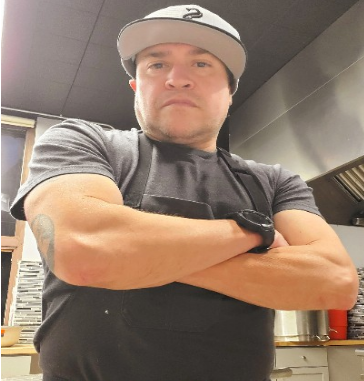
Name: Paul Molina
Location: Chicago
Education: Associates in culinary, pastry & baking, and hospitality management
Business name: American Indian Center of Chicago Food is Medicine Program
Tribal affiliation: Kickapoo, Mexican
What led to your passion for Indigenous foods?
Many people have asked me what makes me passionate about Indigenous foods, or why I am passionate about them. It’s like when someone asks me if I love cooking—I say, “No, I love eating.” Cooking is a lot of work to get to the end result, especially if you’re making food for a large group of people. It’s not just one story, but a handful of experiences that have led me to where I am now.
Back in the 90s, I had a friend who was diagnosed with Hodgkin’s disease. I remember feeling really sad, and when I left the hospital room, I wondered how I could help him. I gave him a medicine pouch that had been gifted to me, and the next day I took one of my feathers and prayed with him.
During his time in the hospital, I went to the library and looked online. I researched home remedies—shark liver, herbal remedies, teas, anything and everything. I knew chemo was going to be hard, but I didn’t know how hard. As my friend went through chemotherapy, I continued to give him advice, along with teas and shark liver pills. He got better, moved on from the cancer, and is doing great now. I’ve always carried with me the understanding that there are powerful medicines out there.
This is where my belief that food is medicine really took shape. As I moved through kitchens and began to see what was healthy and what wasn’t, along with how much waste existed, I knew that one day I would have to step out of that system and make it better—make myself better—and help people as much as I could with what I learned. I’m still doing that to this day.
Why do you think it’s important to make traditional foods accessible for Native people?
As the Chef of the Food Is Medicine program, I want to give my Native elders and seniors as much Native food as possible. I live in Illinois, and farmers grow a lot of corn and soybeans. Is that really good? I’m not an expert, but I would think growing real food to eat, instead of ultra-processed food, would be better. Which brings me to my point—there isn’t much to choose from in Illinois. I source food online from Native purveyors and have it mailed, but I’m limited in what can be sent through the mail. When you go to another country, they usually eat their own cultural foods. You won’t catch me at Mickey Dee’s. So what happened here in the U.S.? As Indigenous people, eating our own culturally relevant foods is healthy and makes more sense. These foods give a sense of pride and a feeling of home that’s embedded in our DNA. That’s why availability is so important in areas with large Native populations, so we can wean ourselves off convenience eating and address the Native food desert.
What is the importance of an Indigenous diet for a healthy lifestyle?
I’m sure that hunting and gathering was a pretty healthy lifestyle, and by all means I’m not trying to go back in time. As a chef, I have to think about how I can mend the two approaches together—seasonally, year-round, and in ways that fit our current living conditions. Of course, an Indigenous diet is a healthy one on many levels. I feel it’s plant-based, includes lean proteins and healthy fats, and represents food as medicine at its best. I’m a firm believer that eating healthy, or having balance, can be an advantage for aging and mental health. When I’m cooking, I try to have balance in every meal, whether it’s one dish or multiple. The older we get, the less movement we tend to have, so to counter that, it becomes inevitable that you have to eat healthy—or you’ll be in trouble if you’re prone to common health downfalls.

What ways are you involved in the education, restoration and accessibility of traditional Native foods?
The way I assert myself into the community is by interacting with people when I feed them. I talk to elders in a way they can understand. What I’m trying to do is give them a healthy, well-balanced meal when they come to see me. Most don’t have allergies, so I can usually introduce something they may have never eaten before.
I also do seed-to-harvest workshops, cooking classes, medicinal teas, videos, and collaborations with Native health organizations. I put together a food box once a month and give advice on what to cook and how to prepare the produce I buy. I encourage everyone to use their smartphones to be smart—look up recipes, techniques, and ways to prepare fruits and vegetables.
With restoration work comes accessibility, and this is where growing Indigenous foods becomes the groundwork. At the American Indian Center (AIC), we have raised beds, traditional beds, and a new hydroponic system. I try to get community members involved, which enables volunteers to come out and work in the garden. Growing and offering Indigenous foods is the way to protect them through demand. Next thing you know, you’re learning, growing, and eating food at the AIC. We’re also involved in prairie restoration work, helping our prairies become healthy again so we can support the future of our small bison herd. With our hydroponic system, we’ll be growing healthy greens and microgreens and helping elders make their own healthy salads.
How can community members be involved and support the cause of restoring and protecting Indigenous food systems?
Community members are encouraged to help in the garden and become volunteers. They can try new foods and be involved in the growing process from seed to harvest. If they have space at home, we encourage them to try growing food there as well. We teach and offer these foods through meals and ask people to suggest meals or foods they’d like to grow or eat. We have plenty of programming that opens up as we move into spring. This past year has been one of the times I’ve felt we were invited into spaces I never thought we’d be part of before. I think most people need to take the leap and try things they’ve never done. Get out of your comfort zone, get dirty and sweaty, and get back to growing your own food and taking care of the land.
Is there anything else you want people to know?
Find a plant you love and grow it wherever you can—through guerrilla planting or even in a small community plot. Purchasing Native products supports Native people doing the work. I also believe that right now we need more allies, friends, and partnerships. We need to be open and attuned to people who want to do the work so we can all benefit while we’re here. Most of my experiences come from urban settings, so things look different in every community. I say be skeptical, but be open.